Electrofusion Welding: Durably & Securely Joining PE Pipes
Imagine this: a leaky PE pipe in civil engineering, water escaping, pressure mounting. The solution? A joining technology that has proven its reliability for decades – electrofusion welding. This proven method creates permanent, secure connections for PE pipes and is part of the standard repertoire of every professional in the construction and utility sector.
What makes this welding technology so special? At its core, the process uses an integrated heating coil that precisely brings plastic parts to welding temperature. The result: homogeneous connections with strengths that match the parent material. Whether in civil engineering, well construction, or domestic installations – wherever PE pipes need to be permanently joined, electrofusion welding demonstrates its strengths. Learn how this process works, when it is superior to other welding methods, and what you need to consider during application.
How exactly does electrofusion welding work?
Electrofusion welding uses integrated heating coils in special couplers to permanently join thermoplastic pipes. The automated process heats the material to 220 to 280 °C, creating an absolutely tight connection after cooling.
Learn more
Which pipe materials are suitable for this welding method?
PE pipes with diameters from 32 mm to 1200 mm can be optimally welded, whereas PEX pipes are not suitable due to their cross-linked structure. The material compatibility between PE 80 and PE 100 also allows for mixed connections.
Learn more
When is resistance welding superior to other methods?
In confined spaces, for repair work, and with varying pipe diameters, the method offers clear advantages over butt welding. The compact design and automated process control increase safety and productivity on the construction site.
Learn more
What safety precautions should be observed during welding?
Besides personal protective equipment such as gloves and adequate ventilation, the qualification of welding personnel is crucial. Regular tests according to DVS 2207 and strict adherence to welding parameters guarantee safe connections.
Learn more
What is resistance welding? The basics of the process
Definition and Principle of Operation
Electrofusion welding is a proven welding method for permanently joining plastic pipes made of thermoplastic materials. In this process, the pipes to be joined are welded using a special coupling that incorporates heating coil wires. During electrofusion welding, electrical current flows through these embedded resistance wires, heating the material to welding temperature and melting the joint surfaces (Wikipedia, 2024).
The method is particularly suitable for semi-crystalline thermoplastics such as polyethylene (PE), polypropylene (PP), and polybutene (PB). Once cooled, the resulting joint is absolutely leak-proof and requires no additional sealing elements – a decisive advantage over mechanical joining techniques.
The Heating Coil as the Central Element
The heating coil is the core of this joining technology. These spiral-shaped resistance wires are directly embedded in the electrofusion fitting and run along the entire welding zone. When current flows through the heating coil, the wire heats up and evenly transfers the heat to the surrounding plastic material.
After 20 years in the industry, I can say: The quality of the heating coil determines the longevity of the entire installation. It's better to invest once in high-quality fittings than to have to carry out expensive repairs later.
The precise arrangement of the heating coil wires ensures a homogeneous temperature distribution throughout the entire joint zone. This is crucial for the quality of the welded joint, as optimal mixing of the melted plastics can only occur with uniform heating.
Welding Process Procedure
The welding process in electrofusion welding follows a precisely defined procedure according to DVS 2207-1. First, the pipe ends are cleaned and prepared. Then, the pipe is inserted into the socket and fixed with a clamping device to prevent axial movements during the welding process (Haustechnikdialog, 2024).
After connecting the welding unit to the fitting's contacts, the automated process begins. The welding temperature and welding time parameters are often read from a barcode attached to the product and automatically set by the device (Unitracc, 2024). The material is heated to 220 to 280 °C, with the exact temperature depending on the material used. The necessary joining pressure is generated by the thermal expansion of the heated plastic. After the welding time and the subsequent cooling phase, an inseparable, homogeneous joint is formed.

Material suitability in coiled-element fusion welding
PE Pipes and their Weldability
Polyethylene pipes are excellently suited for electrofusion welding. This method can be applied to plastic pipes with diameters ranging from OD 32 mm to OD 1200 mm (Wikipedia, 2024). The thermoplastic properties of PE allow for multiple melting and re-solidifying cycles without loss of quality, which is the basic prerequisite for all welding processes.
When welding PE pipes, material compatibility is an important aspect. Pipes made of the same or similar material can be easily joined. Modern PE pipe systems with a protective jacket, such as RAUPROTECT pipes, are just as weldable as standard PE 100 pipes (Haustechnikdialog, 2024).
Differences between PE 80 and PE 100
PE 80 and PE 100 differ mainly in their minimum strength and density. Both material types can be joined by electrofusion welding, with PE 100 being able to withstand higher pressures at the same wall thickness due to its higher strength. The welding parameters must be adjusted according to the material used.
When joining different PE types, special care is required. In principle, PE 80 and PE 100 can be welded together, as both belong to the same material group. The welding temperature and time are based on the material with the higher requirements to ensure a secure connection.
Why PEX Pipes are Not Weldable
PEX pipes (cross-linked polyethylene) fundamentally differ from conventional PE pipes. Due to the cross-linking of the molecular chains, the material loses its thermoplastic properties and becomes a thermoset. This means that PEX pipes cannot be remelted after cross-linking without destroying the material.
For pipes made of RAU-PE-Xa, butt welding with a heating element is currently not possible (Haustechnikdialog, 2024). However, these pipes can be welded with commercially available electrofusion fittings, as only the outer layer of the pipe is melted here, and the connection mainly occurs via the sleeve.

Electrofusion Welding vs. Other Welding Methods
Comparison with Socket Fusion
Electrofusion is often compared to conventional socket fusion welding, as both methods use fittings. The key difference lies in the method of heat generation: while socket fusion uses an external heating element, electrofusion heats the joint directly through integrated heating wires within the fitting.
This joining technology offers several advantages: temperature control is more precise because the heating coil is located directly in the weld zone. In addition, there is no need to handle hot tools, which increases workplace safety. The automated process control in electrofusion also reduces the error rate due to human influence.
Advantages over Butt Welding
Heated element butt welding is considered the most important method for joining PE-HD pipes (Egeplast, 2024). Nevertheless, electrofusion offers decisive advantages in many situations. Its superiority is particularly evident in confined spaces or when working in trenches: the compact welding device and easy handling enable connections even where a butt welding machine cannot be used.
Another advantage lies in joining pipes with different wall thicknesses or diameters. While butt welding requires identical pipe cross-sections, electrofusion fittings can easily join different dimensions. Welding time is also usually shorter, which increases productivity on the construction site.
When to Use Which Method
The choice of the optimal welding method depends on various factors. Electrofusion is particularly suitable for repair work, house connections, and situations with frequent changes of direction. For straight pipeline sections with large diameters, however, butt welding is often more economical.
For use in house connections, in addition to welding processes, mechanical connections such as push-fit and clamp connection techniques are also an option (Egeplast, 2024). However, these are only suitable for certain applications and do not achieve the tightness and durability of welded connections. In pipeline construction for gas and water supply, electrofusion has established itself as the standard method.

Main Applications of Electrofusion Welding
Use in Civil Engineering
In civil engineering, electrofusion welding is an indispensable joining technology. It is standard practice for laying utility lines for gas and water (Wikipedia, 2024). The robust connections optimally withstand mechanical stresses from ground movement and traffic loads.
The advantages are particularly evident when retrofitting house connections to existing main lines: With special tapping valves and saddles, branches can be created without interrupting the supply. The compact welding devices also allow work in confined trenches or shafts.
Applications in Well Construction
In well construction, piping systems must withstand extreme conditions. Electrofusion welding ensures permanent and absolutely tight connections that resist water pressure and potential chemical loads. Homogeneous welding prevents weak points where corrosion or material fatigue could occur.
For PE well casings, larger diameters are often used. Here, another advantage of the process becomes apparent: even with pipe diameters of several hundred millimeters, precise connections can be made with appropriate holding devices. Positioning is carried out using special centering systems that ensure exact alignment of the parts to be welded.
Building Services and Utility Lines
In building services, electrofusion welding has established itself as a reliable joining method for PE pipelines. Whether for drinking water pipes, heating pipes or sewage systems – the versatility of the process allows its use in various areas. The connections meet all relevant DVGW requirements and guarantee hygienically perfect installations.
Modern piping systems in building services often require complex pipe routing with numerous changes of direction. Electrofusion fittings are available as elbows, T-pieces and reducers in various designs. This allows flexible adaptation to structural conditions without loss of quality in the connections.
Safety Precautions for Hot Wire Welding

Personal protective equipment
Safety in electrofusion welding begins with the correct personal protective equipment. Although the process is considered relatively safe compared to other welding methods, protective measures are still necessary. Work gloves protect against hot surfaces that can arise during the welding process.
As fumes can be generated when thermoplastic materials are heated, adequate ventilation must be ensured. When working in confined spaces or shafts, a respirator may be required. Safety shoes with puncture-resistant soles are mandatory on construction sites anyway and additionally protect against falling pipe sections.

Workplace design
A well-organized workplace significantly contributes to safety during welding. The clamping device must be placed on a firm, level surface to prevent slipping during the welding process. Power cables must be routed in such a way that they do not pose a tripping hazard and cannot be damaged.
The welding zone should be kept free of flammable materials. Although temperatures are controlled during electrofusion welding, hot surfaces can still pose a fire hazard. A fire extinguisher should always be readily available. When working in trenches, ensure adequate shoring to prevent collapse.

Important safety rules
The most important safety rule concerns the qualification of welding personnel. Only trained and certified welders are permitted to carry out electrofusion welding. The re-certification test according to DVS 2207 must be taken regularly to maintain the welding authorization (Wikipedia, 2024).
Before each welding process, the welding machine must be checked for damage. Defective cables or damaged plugs can lead to dangerous situations. The specified welding parameters must not be changed independently, as this can impair the quality of the joint and pose safety risks. After welding, the prescribed cooling time must be observed before the joint is subjected to stress.
PE Welding Technology Products for Professional Electrofusion Welding
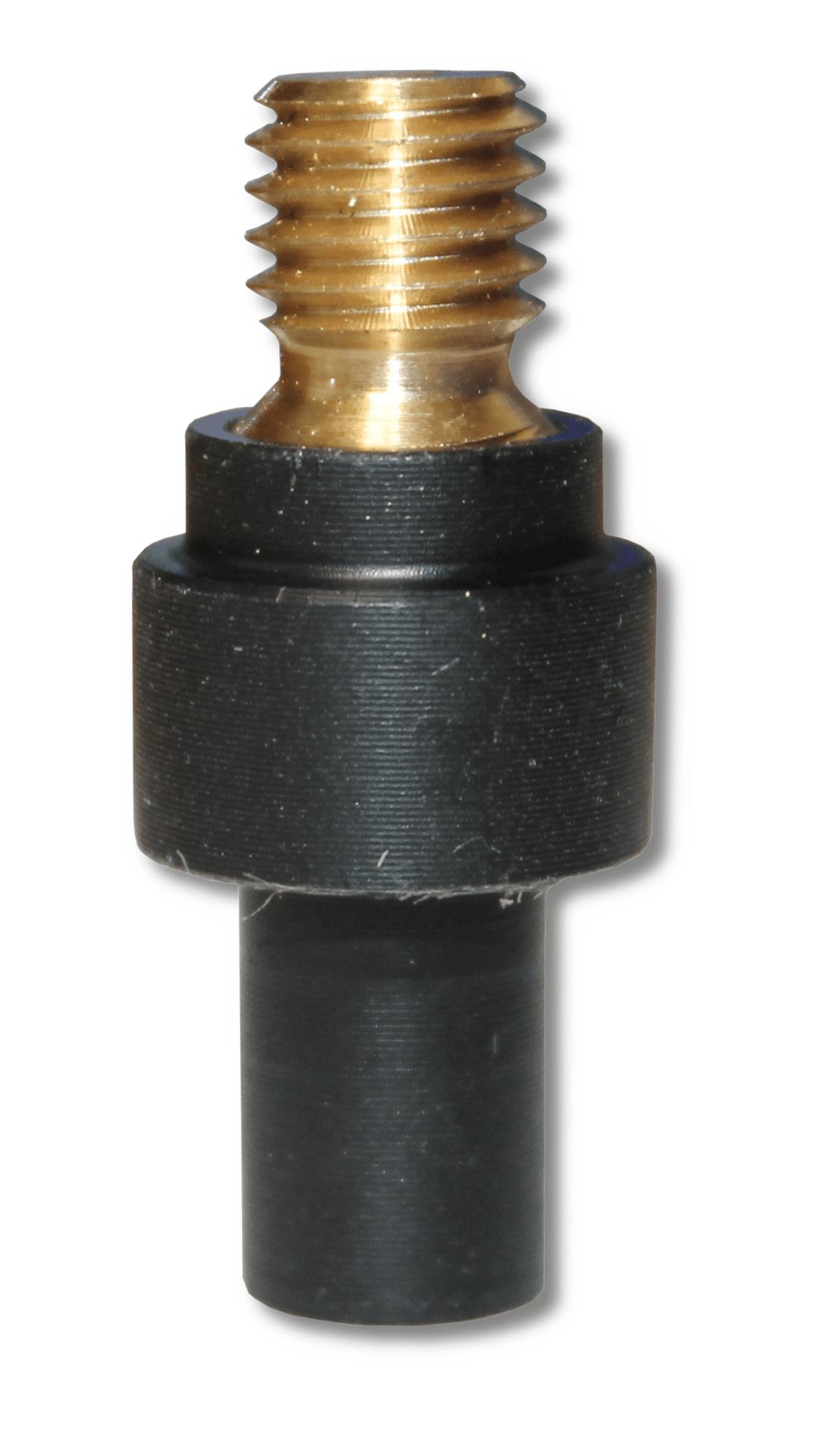
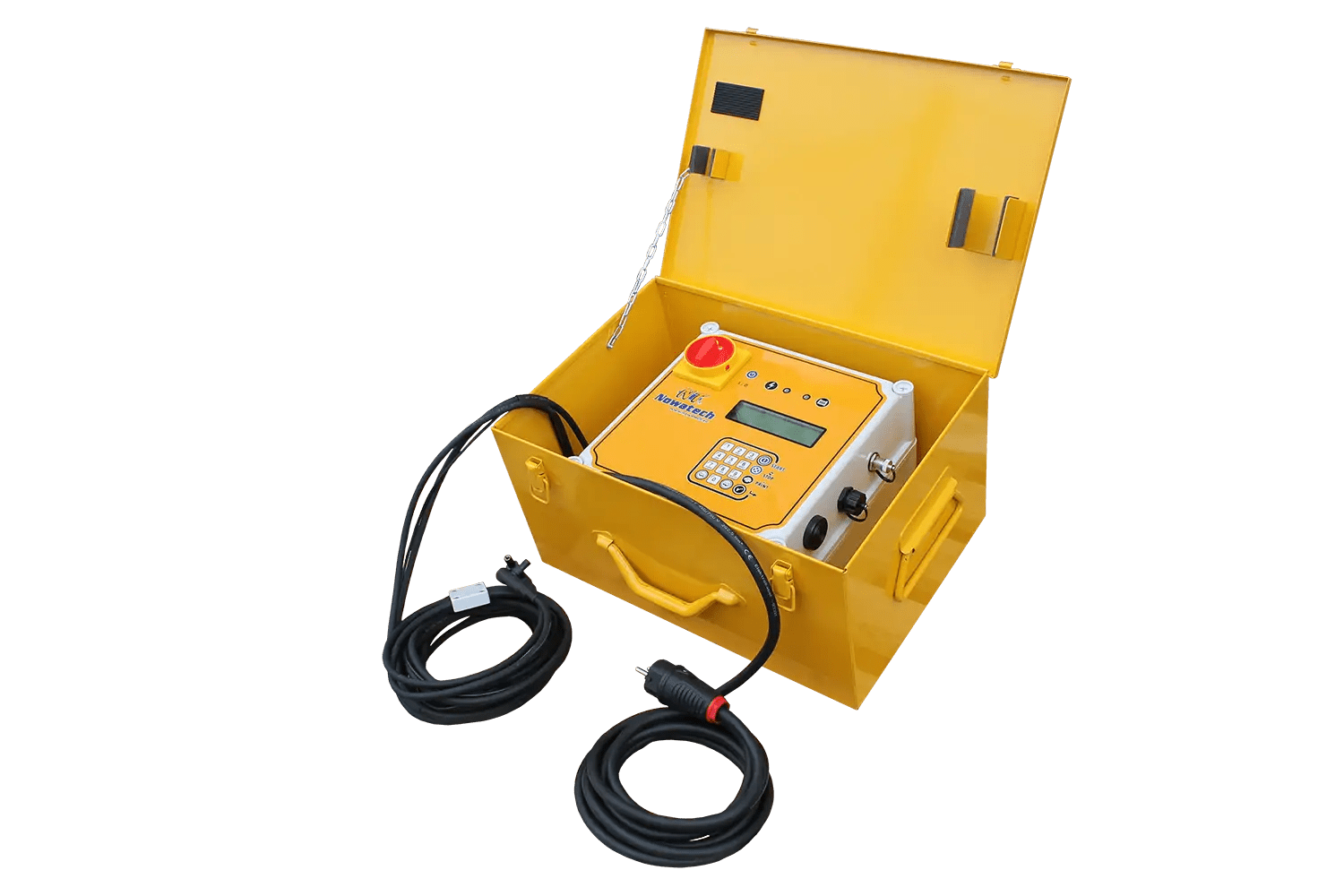
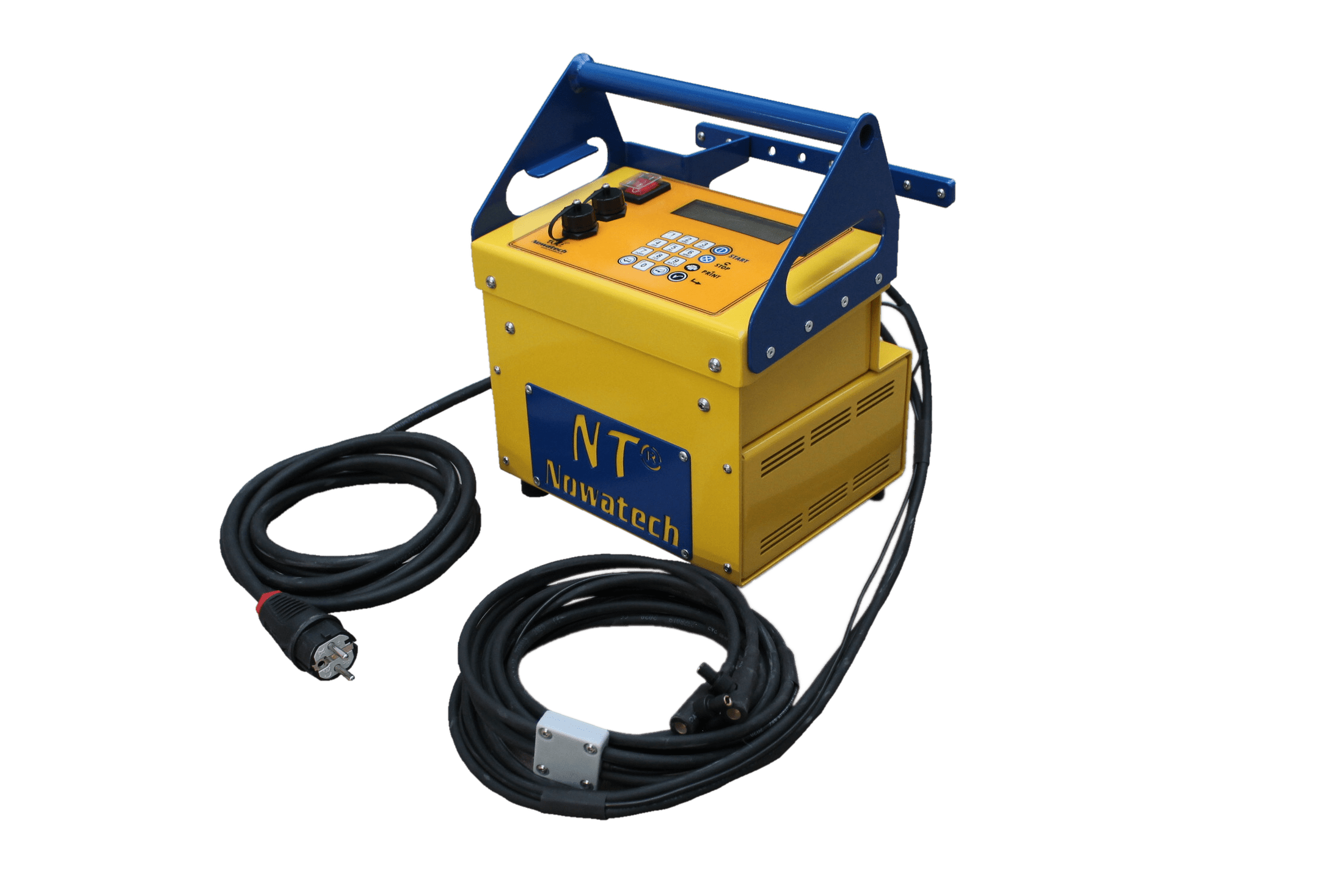
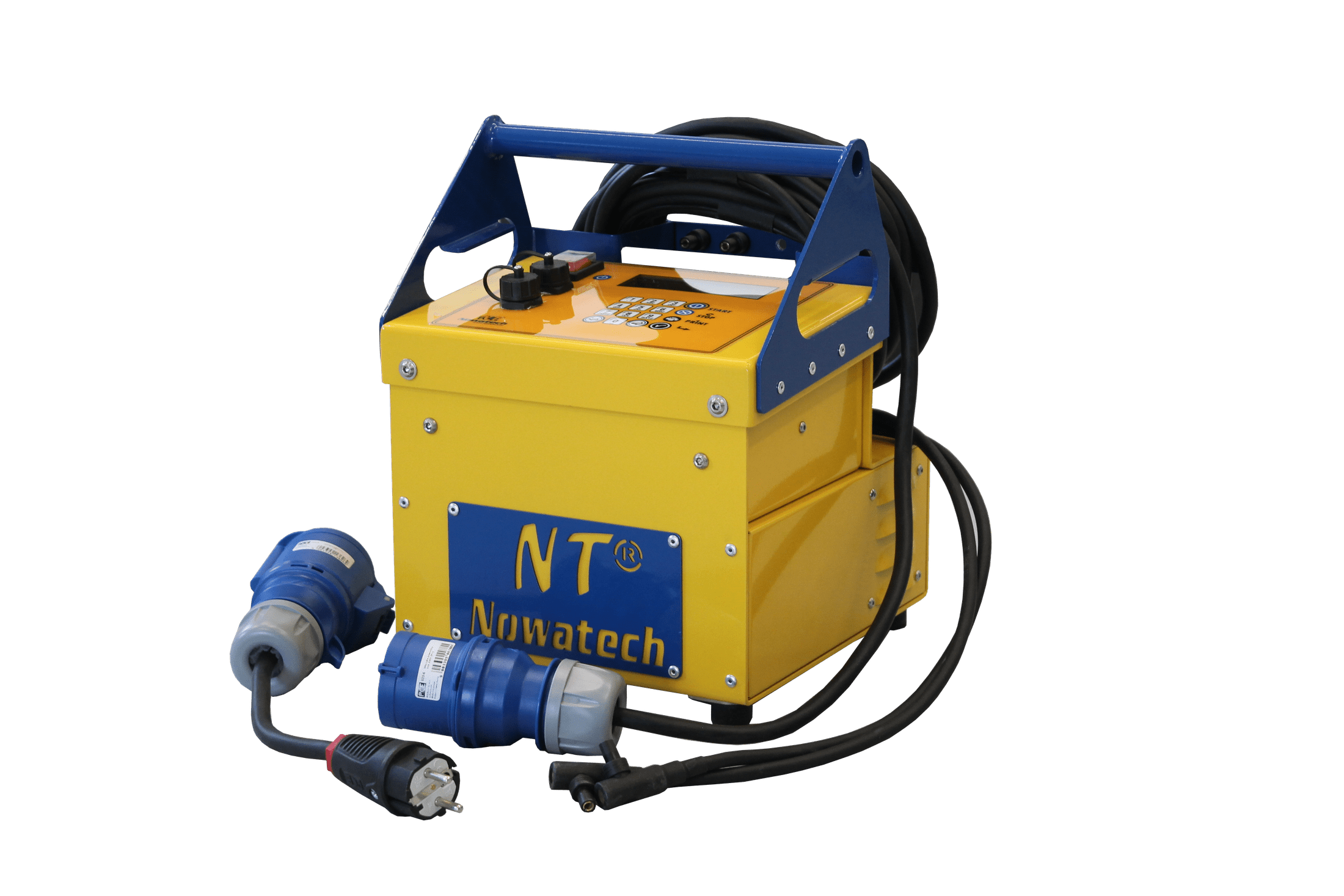
For professional users in the field of plastics processing, PE Schweißtechnik offers a powerful electrofusion welding machine, the ZEEN-2000. This electrofusion welder was specially developed for the requirements of pipeline construction and welds fittings and sleeves from 20 to 400 mm in diameter.
The ZEEN-2000 is characterized by modern features that simplify daily work: The integrated storage and logging function meticulously documents every welding process – an important aspect for quality assurance. Data can be easily transferred to a computer via the USB interface. The optionally available barcode scanner allows for quick reading of welding parameters directly from the fitting, which eliminates errors in manual entry and accelerates the welding process. With 20 years of expertise in welding technology, PE Schweißtechnik stands for outstanding value for money and offers an extensive range for all requirements of PE welding technology.
Coil welding
Frequently Asked Questions about Resistance Welding
In electrofusion welding, electric current flows through resistance wires embedded in a special sleeve – this heats the material to 220-280°C and permanently fuses the pipes together. The welding process is fully automated: after scanning the parameters via barcode, the device starts the process, during which the heating coil evenly heats the surrounding plastic material, creating a homogeneous joint.
PE pipes are joined together by thermal melting and subsequent cooling under pressure. The most common methods are: • Electrofusion (with couplers/fittings) • Hot plate butt welding (direct pipe connection) • Extrusion welding (for special cases)
Sleeve welding refers to welding processes in which pipes are joined using a sleeve (fitting) – classic sleeve welding uses an external heating element, while electrofusion welding generates heat directly in the sleeve through integrated heating wires. The advantage of the electrofusion method lies in more precise temperature control and the elimination of handling hot tools.
PEX pipes (cross-linked polyethylene) cannot be welded like regular PE pipes because they have lost their thermoplastic properties due to cross-linking. However, PEX pipes can be connected with special electrofusion fittings, where only the outer pipe layer is melted.
Electrofusion welding is suitable for plastic pipes with diameters ranging from 20 mm to 1200 mm. Professional welding machines like the ZEEN-2000 typically cover the 20-400 mm range, which is sufficient for most applications in civil engineering and building services.
Yes, only trained and certified welders are permitted to carry out electrofusion welding – qualification is according to DVS 2207 and must be regularly renewed. This requirement ensures the quality of the joints, especially in safety-critical applications such as gas and drinking water pipelines.
Electrofusion welding has established itself as an indispensable joining technology for thermoplastic pipelines. The integration of heating wires directly into the socket allows for precise temperature control and automated process management – decisive advantages over traditional welding methods. Particularly in civil engineering, well construction, and building services, its superiority is evident in confined spaces and complex pipe layouts. With professional equipment like the ZEEN-2000 from PE Schweißtechnik, durable, absolutely leak-tight connections for gas, water, and sewage pipes can be achieved. The investment in high-quality welding technology pays off through process reliability, seamless documentation, and long-lasting pipe connections.